
An Introduction to Padel Court Dimensions and Rules
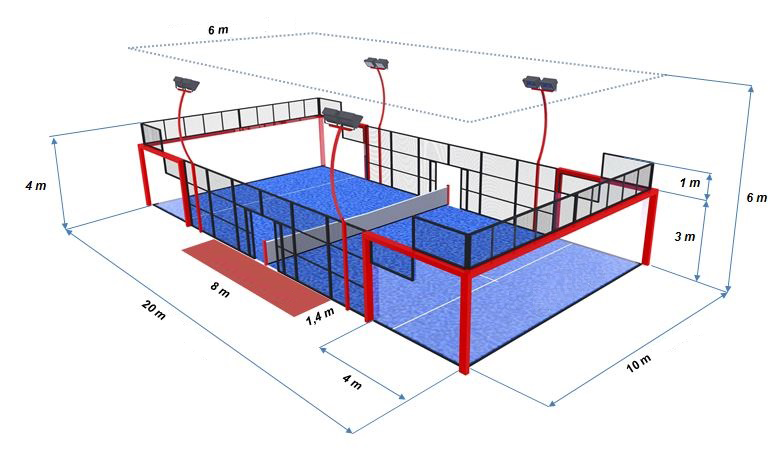
The Padel Court: A Glass Box of Action
The most striking feature of Padel is its court. It’s smaller than a tennis court and enclosed by walls, which are very much part of the game.
Court Dimensions
-
Playing Area: The court is a rectangle 20 meters long by 10 meters wide.
-
Net: A net divides the court in half and has a height of 88 cm in the center, rising to 92 cm at the posts.
-
The Enclosure:
-
Back Walls: The back of the court is enclosed by a solid wall, typically tempered glass, to a height of 3 meters.
-
Side Walls: The side walls are a combination of glass and metallic mesh. The walls are in play, creating unique angles and exciting rallies.
-
The Rules of the Game
Padel is almost always played as doubles. The scoring is identical to tennis, but the gameplay has some key differences.
Scoring
-
Padel uses the same scoring system as tennis: 15, 30, 40, and game.
-
A score of 40-40 is called “deuce.” A team must win two consecutive points from deuce to win the game (the first is “advantage,” the second is “game”).
-
A set is won by the first team to win 6 games with a margin of at least 2 games. A match is typically the best of 3 sets.
The Serve
The Padel serve is very different from a tennis serve.
-
The server must let the ball bounce once behind the service line before hitting it.
-
The ball must be struck at or below waist level.
-
The serve is hit diagonally into the opponent’s service box. If it hits the net and lands in, it’s a “let” and is replayed.
Gameplay and Using the Walls
This is where Padel truly shines.
-
In-Play: A ball is in play after it crosses the net and bounces on the opponent’s side of the court.
-
Playing off the Walls: After the ball bounces on the ground, it can then rebound off any of the walls and still be played by the receiving player. Players can even use their own glass back wall to return a difficult shot.
-
Faults: A ball is out if it hits an opponent’s wall directly before bouncing on the ground. A player also loses the point if they hit the ball into the side mesh or the ball hits any fixture before going over the net.
Padel’s blend of easy-to-learn mechanics and deep, wall-bouncing strategy makes it a perfect social sport. So grab a partner, find a court, and get ready to play off the wall!